D
H
M
S
Offer
Provide additional details about the offer you're running
FLASHSALE


The Praxis Core Math Exam is designed to measure prospective teachers’ abilities to understand and apply mathematical concepts and skills.
The exam covers a range of topics, including algebra, geometry, and data analysis and will require you to use equations, proportions, logical reasoning, and complex mathematical practices to solve problems.
The Praxis Math (5733) is just one of three sections of the Praxis Core. The test also includes Reading (5713) and Writing (5723).
Did you know: All sections of the Praxis core are scored separately. For example, let’s say that you pass the reading section and writing section, but fail the math. In this case, you will only have to retake the math section.
The Praxis core math test consists of three main content categories:
This section requires you to solve problems involving integers, decimals, fractions, ratios, and proportions. In addition, you will have to solve real-life word problems. Here are a few examples of what that might look like on the exam.
The height of a tree can be found using similar triangles. A 12-foot tall tree casts a 7-foot shadow. If a nearby tree casts a 5-foot shadow, how tall is the tree?
Correct Answer: B

For this question it is helpful to draw a picture and label the lengths.

Next, use the picture to set up the proportion. Notice that the labels on the picture are already in the right place for a proportion.
Finally, cross multiply and solve for x.

Order the following from least to greatest
Correct Answer: C

Convert all fractions to decimals and order the numbers from least to greatest.
Quick Tip: Before changing the numbers all to decimals, look at the answer choices to see if you can narrow down the options.
Because we are ordering least to greatest, the negative number must be in the first position. Therefore, we can eliminate any answer choice that does not have the negative value listed as the first number.
This section of the exam covers topics such as measures of central tendency (mean and median), scatter plot graphs, correlation, and causation. Here are a couple of examples from this section of the test.
In a recent survey of 120 people at a grocery store, 20% said they were there to buy snacks, 45% said they were there for their weekly shopping, 15% said they were there to buy lunch, and the remaining people were there to purchase non-grocery items.
How many people surveyed are buying non-grocery items?
Correct answer: C
Subtract the percents given from 100 to get the percent of people shopping for non-grocery items.
100 – 45 – 15 – 20 = 20. Next, find 20% of 120 people, 0.20 ⋅ 120 = 24
Find the median age given in the table.
Correct Answer: 1

The frequency in the table refers to how many times the number repeats in the list. Age 30 appears 7 times, with 4 numbers to the left, and 5 numbers to the right.
Without writing out the entire list, we can deduce that 30 is the middle number (if this is not apparent, write out the list if small enough).
The scatter plot displays the relationship between a person’s arm span and their height.
Based on the graph, what type of correlation exists between the two data sets?
Correct Answer: 1
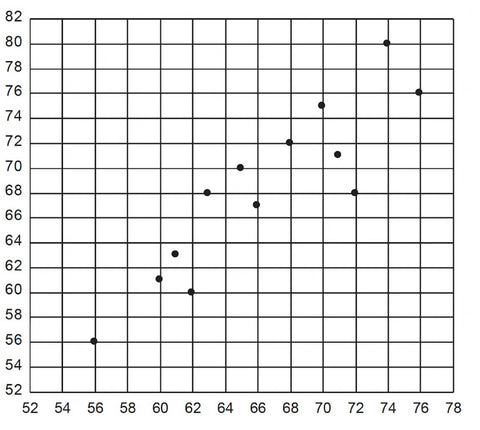
The data is close together and increasing, so there is a high positive correlation. If it appeared that the data was increasing but was spread out, or far from a trendline, the data would indicate a loose or weak positive correlation.
This section requires you to demonstrate an understanding of the properties (commutative, associative, and distributive) of the basic operations.
You will also have to solve linear and quadratic equations. In addition, you will have to use basic properties of common two-dimensional shapes and basic angles to solve problems.
You will also have to solve problems using formulas for three-dimensional shapes like spheres, rectangular prisms and pyramids. Here are a few example problems.
A circle with a radius of 3 inches has a central angle that measures 40º. What is the length of the intercepted arc?
Correct Answer: B

To solve this problem, use a proportion, filling in the missing values to solve for arc length.
Which of the following cereal boxes holds the most cereal?
Correct Answer: 2

Find the volume of each box by multiplying length x width x height. Box B has the largest volume and can hold the most cereal.
While the Praxis Core Math 5733 exam is referred to as “basic skills exam,” it’s actually quite difficult.
You can see from the practice questions above that this exam will require you to apply a multitude of skills in different mathematical areas.
The skills needed to pass this exam are comparable to the skills required of tenth-grade students in public education.
The test is similar to the ACT and SAT.
You might be thinking, I graduated high school, I certainly have the skills of a tenth grader. Please don’t underestimate this exam. The first-time pass rates for many Praxis exams are less than 50%.
Many people think because this is considered a basic skills test, they won't have any trouble passing. However, it’s probably been a while since you’ve solved problems using proportions or linear equations.
You’re going to have to dust off some skills you haven’t used since middle or high school in order to pass the exam.
Without studying properly, it could take several attempts to pass. This can be quite costly and time consuming.
To prepare for the Praxis Core Math Exam and maximize your chances of passing it's essential to review the content that will be covered on the exam and to practice with sample questions.
You will want to review the specific skills outlined in the test specifications for the test.
There are many resources available that can help you prepare, including study guides and practice exams. By studying effectively and putting in the necessary time and effort, you can increase your chances of success on the Praxis Core Math Exam.

Obviously, we believe our Praxis Core study guide is the very best resource you can purchase to prepare for the Praxis Core for three key reasons:
In each section, there are practice items that align specifically with the skills you just studied, so you can see exactly what a question for that skill or content will be like on test day. In addition, we have detailed answer explanations for every question in our study guide. This ensures you know why you got something correct or incorrect.
Finally, our study guide contains two-three, full-length practice tests with s at the end of each subtest. Therefore, you have hundreds of practice questions to work with.
Here is an example of how we provide you with comprehensive answer explanations for every practice question in our study guide.
It is very important that you not only understand how to solve the problem, but also what content category the skills come from. This will help you identify specific areas you can improve in. We provide all of that information in our answer explanations.

We sort every practice test question by test skill. This helps you identify the skills in which you are low, so you can go back and study those aspects of the study guide. Knowing what skill the questions assess is a huge benefit to your studies.
The study guide is an amazing resource to help you pass the Praxis Core. However, you might need more support in one or more areas. In that case, we have online courses packed full of video tutorials and extra practice.
Our Praxis Core online course also includes the digital study guide. If you need more support, you can check out our Praxis Core online course. Like the study guide, you can purchase the whole course or individual subtests.
We have free Praxis Core webinars that contain presentation materials and practice test questions.
You can also find free practice test questions in the ETS study companion. This document contains the specifications, blue print, sample items, and explanations.
Many people want to purchase a study guide with the same questions as the exam. However, this is not only against testing regulations, but it is also impossible.
State tests are secure, standardized, and heavily regulated. No one is privy to the questions on teacher certification exams.
ETS–the company that makes the exam–has hundreds of test questions in their item banks for each exam.
When you take the exam, your version of the test has questions randomly pulled from these item banks. Therefore, trying to memorize what you think will be on your test is an exercise in futility.
Instead, you should study the skills and content outlined in the specifications and blueprint of the exam. To learn more about testing administration and how item banks work, check out this video.
We provide the test specifications and blueprints for the exam in our study guides. That way, you can review how the test is designed and what skills are assessed.
In fact, the questions in our study guide are structured similarly to what you will encounter on test day. We align all of our questions to the test specification and blueprint.
This ensures you’re studying the content and practicing the skills you will need to be successful on the exam.
We get this question a lot, and there is no simple answer. People’s abilities vary greatly when it comes to the skills needed to pass the test.
However, we always recommend incremental practice over an extended period of time rather than cramming all your studies into one weekend before the test.
Ideally, you would spend 20-30 minutes a day for 2-3 weeks to prepare for the math portion of the Praxis exam.
When you sign up for our Free Praxis Core webinars, you will get a suggested study plan to help you organize your time as you prepare for the test.
The most effective way to prepare for this exam is to practice regularly. We recommend incremental practice over an extended period of time. For example, carving out 20 minutes every day for 2-3 weeks is much better than cramming your studies into one weekend before the test, especially if you struggle with these skills.
You can also catch some of our previously recorded live sessions on our YouTube channel. There you will find over a year’s worth of lessons, and you can download the problems we cover in each session.

In this blog post, we’re breaking down one of the most important responsibilities of instructional leaders: using assessment data to...

In this blog post, we are going to walk step-by-step through how to tackle a constructed response question on your...

In this blog post, we’re talking about resiliency in leadership—what it really means to be a resilient leader and why...

In this blog post, we’re breaking down exactly what you need to know to succeed on your ESOL or ESL...

In this blog post, we’re going to unpack the new Praxis Early Childhood Education exam called Praxis Early Childhood: Foundational...

In this blog post, we’re breaking down a simple but powerful approach to special education certification exams (like the 5355...

In this blog post, we’re breaking down one of the most important ideas in instructional leadership: using data to drive...

In this blog post, we’re going to walk through what “test thinking” actually looks like when you’re facing reading instruction...

In this blog post, we’re talking about strategic leadership with a specific focus on data analysis—one of the most important...

In this blog post, we’re going to break down exactly how to approach the open-response (constructed response) portion of reading...

In this blog post, we’re diving into Strategic Leadership, the very first content category on the SLLA 6990 and Praxis...

In this blog post, we explore the foundations of reading and the importance of teaching with clear intention and strategy,...

In this blog post, we are going to break down numbers and operations, one of the most important and most...

In this blog post, we'll break down the key differences between the SAT and ACT to help you decide which...

In this blog post, we will explore the overall structure of the SAT, a crucial exam used by many colleges for...

In this blog post, the focus is on three essential components of effective reading instruction: comprehension, metacognition, and critical thinking....

In this blog post, the focus is on the foundations of reading—specifically systematic and explicit instruction—and the ongoing debate around...

In this blog post, the focus is on the messy, beautiful, and often overwhelming journey of becoming a teacher —...

In this blog post, discover simple, repeatable patterns for cracking scenario-based questions on certification exams like the PLT and the...

In this blog post, we’re breaking down one of the most misunderstood punctuation marks—the semicolon. Whether you’re studying for the...

In this blog post, we’re diving into how to use ChatGPT and other AI tools to practice for the constructed...

In this blog post, we’re diving into everything you need to know about the Praxis Core, sometimes referred to as...

In this blog post, we’re diving into the Principles of Learning and Teaching (PLT) exam—also known in some states as...

In this blog post, we’re going to tackle a common but stressful situation: failing your teacher certification exam. If this...

In this blog post, we’re diving into the key differences between the Praxis Elementary Education 5001 and the Praxis Elementary...

In this blog post, we’re diving into the differences—and the similarities—between the Foundations of Reading exam, the Praxis 5205/5206 Teaching...

In this blog post, MTSS—short for Multi-Tiered System of Supports—is unpacked in clear, practical terms, with examples for the classroom...

In this blog post, we dive into Section I of the SLLA 6990 (and Praxis 5412), which focuses on Strategic...

How many do I have to get correct to pass the Praxis test? There are no definitive passing scores on...

In this blog post, the complex process of teacher certification testing is broken down to help new educators navigate the...

In this blog post, we’re diving into a powerful time-saving technique for acing constructed response questions on teacher certification exams—working...

In this blog post, we're diving into the mathematics section of the Praxis Elementary Education 5003 exam. Many aspiring teachers...

In this blog post, we’re diving into sample questions from the Praxis 5002 (Reading and Language Arts) subtest of the...

In this blog post, we're diving into one of the most common questions aspiring teachers ask: "What certification exams do...

In this blog post, we’ll explore how new teachers—whether recent graduates or career changers—can thoughtfully choose the right subject area...

In this blog post, I’ll walk you through the essential steps to becoming a certified teacher in the United States....

In this blog post, we’re going to explore an effective test-taking strategy that will help you quickly identify correct answers...

In this blog post, we’re diving deep into Bloom’s Taxonomy—what it is, how to understand it, and how to apply...

In this blog post, we are diving into an essential reading comprehension strategy called close reading. This method is widely...