D
H
M
S
Offer
Provide additional details about the offer you're running
FLASHSALE


The Praxis Core Writing exam consists of two parts: a selected-response section and a text-production section, which is an essay task.
The selected-response section tests your knowledge of grammar, usage, and mechanics, as well as your ability to revise and edit written materials.
The text production section requires you to write two essays: one in which you analyze a given source text and one in which you present and defend your own position on a given topic.
In general, the Praxis Core Writing exam is designed to assess the writing skills of prospective educators, so it is important to have a solid foundation in grammar, usage, and mechanics, as well as the ability to write clear and concise essays.
To increase your chances of success on the exam, it is important to review the content that will be tested and practice your writing skills in advance.
While the Praxis Core Writing 5723 exam is referred to as “basic skills exam,” it’s actually quite difficult. The skills needed to pass this exam are comparable to the skills required of tenth-grade students in the areas of reading, writing, and math. The test is similar to the ACT and SAT.
Many people ask, “Why can’t I pass the Praxis Core Writing?”
Like the reading and math section of the exam, the test requires you to apply skills you may not have used for a while, especially if you have been out of school for a number of years.
Also, the first-time pass rate for many Praxis exams is less than 50%.
The difficulty of the Praxis Core Writing exam can vary depending on an individual's writing skills and familiarity with the content that is tested. Even for those who have strong written and communication skills, this exam can be particularly challenging.
The exam requires you to understand grammar concepts like subject-verb agreement, pronoun antecedent, prepositional phrases, punctuation, and more.
You will also have to apply these skills to the writing task of the text production section. While you might be familiar with these concepts in your everyday communication, the way they are presented on the exam can be challenging for anyone.
In addition to reviewing the content that will be covered on the exam, it is also important to manage your time effectively during the exam. This includes reading the prompts carefully, planning your essay before you begin writing, and leaving time to revise and edit your work.
You will only have 30 minutes for each essay. That time evaporates quickly, and if the clock runs out before you have a chance to finish, the computer will automatically submit what you have written.
We recommend mapping your essay before you write. Planning your essay first by using a quick outline takes a little bit of time at the beginning, but it will save you lots of time in the end.
If you choose to just write without planning, your essay will be disorganized and you will have to spend more time revising.
It is difficult to predict exactly how many questions you will have to get correct to pass the Praxis Core because a scale score is used rather than a raw score. This simply means that your raw score–how many you got correct–is put into a formula to calculate a scale score.
We recommend scoring 75% of the questions correct on the selected-response portion. Achieving at least 75% correct on the practice tests indicates that you are ready to take the actual exam.
Remember, each section of the exam is scored separately. There is an essay section that is scored differently than the selected-response section. Both scores are then combined for an overall score.
The essay portion of the Praxis Core Writing exam is scored by trained evaluators who are knowledgeable about the skills and knowledge that are being tested on the exam. These evaluators use a standardized scoring rubric to assess the quality of the essays written in response to the prompts on the exam.
The scoring rubric used for the Praxis Core Writing exam is designed to assess the quality of the essays in terms of their content, organization, development, and language use. It is broken down into four main categories:
Each of these categories is scored on a scale from 1 to 6, with 6 being the highest score. The scores from each category are combined to provide a final score for the essay.
The essay portion of the Praxis Core Writing exam is scored in this way to ensure that it is fair and objective, and to provide a consistent basis for evaluating the quality of the essays written in response to the prompts on the exam.
Most people think because they scored a 6 they have passed the exam, yet the score report conveys a non-pass. A score of 6 means you received a 3 from each evaluator, resulting in a 6 out of 12 or a 50%.
This is not enough to pass the essay. You need at least a 4 from each evaluator, which results in a total score of 8 out of 12.
You can take a look at our detailed blog post that covers how Praxis exams are scored and how you can calculate your score.
We believe our Praxis Core study guide is the very best resource you can purchase to prepare for the Praxis Core. Our Praxis Core test prep is 100% aligned to the exam.
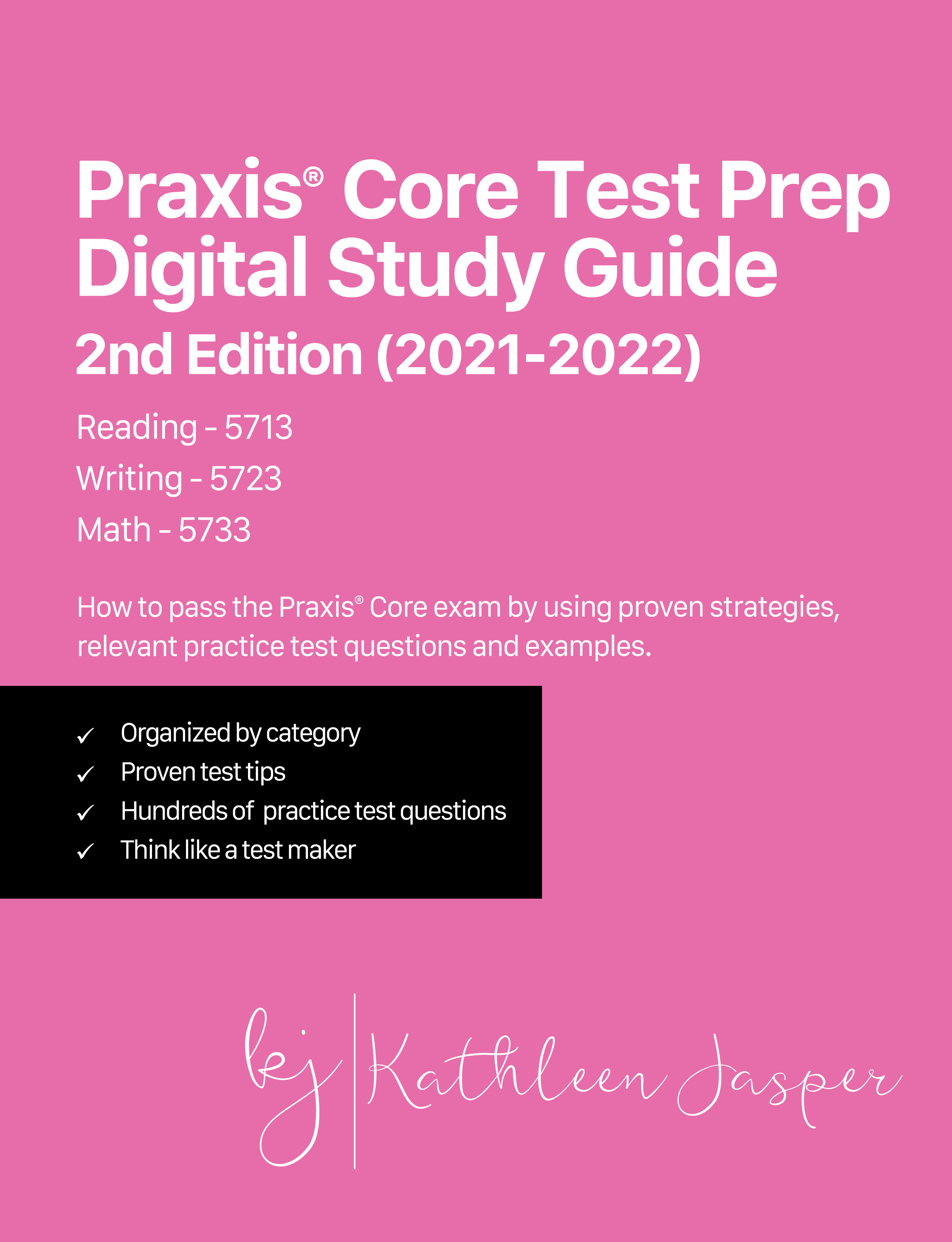
The Praxis Core study guide book is sectioned out by subtest, and within those subtests we’ve aligned all of the information to the test specifications and blueprint. This ensures you are studying what you will see on test day–nothing more, nothing less.
In each section, there are practice items that align specifically with the skills you just studied, so you can see exactly what a question for that skill or content will be like on test day.
In addition, we have detailed answer explanations for every question in our study guide. This ensures you know why you got something correct or incorrect. Finally, our study guide contains two-three, full-length practice tests with answer explanations at the end of each subtest. Therefore, you have hundreds of practice questions to work with.
We sort every practice test question by test skill. This helps you identify the skills in which you are low, so you can go back and study those aspects of the study guide. Knowing what skill the questions assess is a huge benefit to your studies.
The study guide is an amazing resource to help you pass the Praxis Core. However, you might need more support in one or more areas. In that case, we have online courses packed full of video tutorials and extra practice.
Our Praxis Core online course also includes the digital study guide. If you need more support, you can check out our Praxis Core online course. Like the study guide, you can purchase the whole course or individual subtest.
People have a range of abilities and skill levels when it comes to writing. Therefore, it is difficult to tell you exactly how long you should study for the exam. However, you can measure your skills and then gauge how long you will need to prepare.
First, use one of the practice tests in the back of our study guide as a pretest. Take this before you do any preparation. Score your test and use that as a baseline. Do this without looking at the answer explanations. That way, you can use the pretest again.
Next, study the skills and concepts in the book. Identify where you struggle and hone in on those concepts and skills.
Then, retake the pretest. Note where your score increased and areas where you still need to improve. This time, look over the answer explanations and examine the correct and incorrect answers. Then go back into the study guide and refine those areas.
Finally, take the other practice test in the book and use it as a post test. If you score above a 75% correct, you are ready to take the real exam.
Read through the argumentative and source-based writing portion of the study guide. You may also want to watch our YouTube videos on the Praxis Core Writing. Become familiar with the process of mapping, organizing, writing, and proofreading your essay.
Next, use one of the sample prompts in our book to write an essay for time. There are several prompts in the book to use. Write your essay within 30 minutes. Then use the rubric in the book to score your essay. Be honest with yourself as to where you fall on the rubric. Identify areas in which you need to improve.
Repeat this process for both the argumentative and source-based essay. Continue to practice using the sample prompts and essays in our study guide. Once you score a four on the rubric provided in the study guide, you are ready to take the real exam.
We have free Praxis Core webinars that come with free study guides and practice test questions.
Our webinars for the Praxis Core Writing include two playlists: one for the grammar and one for the essay. The videos and resources cover the skills needed to pass the selected-response and essay portion of the exam.
You can also find free practice test questions in the ETS study companion. This document contains the specifications, blue print, sample items, and explanations.
We get this question whether study guides have the same questions as the real exam all the time. People want to purchase a study guide that mirrors the exam.
However, state tests are secure, standardized, and heavily regulated. No one is privy to the questions on teacher certification exams. Also, it’s against testing policy to share items you see on your certification exams.
Just like students are not given the exact questions on their state exams, you will not have the opportunity to know exactly what is on your certification tests.
In addition, there is no way to know what questions you will get on your specific test. ETS–the company that makes the exam–has hundreds of test questions in their item banks for each exam.
When you take the exam, your version of the test has questions randomly pulled from these item banks. Therefore, trying to memorize what you think will be on your test is an exercise in futility. Instead, you should study the skills and content outlined in the specifications and blueprint of the exam.
We provide the test specifications and blueprints for the exam in our study guides. That way, you can review how the test is designed and what skills are assessed. In fact, the questions in our study guide are structured similarly to what you will encounter on test day.
We align all of our questions to the test specification and blueprint. This ensures you’re studying the content and practicing the skills you will need to be successful on the exam.
To prepare for the Praxis Core Writing exam, it is important to review the skills and knowledge that will be tested.
This includes reviewing grammar, usage, and mechanics rules, as well as practicing your ability to revise and edit written materials.
It is also helpful to familiarize yourself with the types of prompts that may be used on the written essay section of the exam and practice writing essays in response to these prompts.
The most effective way to prepare for this exam is to practice regularly. We recommend incremental practice over an extended period of time. For example, carving out 20 minutes every day for 2-3 weeks is much better than cramming your studies into one weekend before the test, especially if you struggle with these skills.
On our YouTube channel we have many videos to help you with grammar and writing. We also have a specific playlist just for the Praxis Core Writing that includes videos for the selected-response and essay portion of the exam.

In this blog post, we are going to walk step-by-step through how to tackle a constructed response question on your...

In this blog post, we’re talking about resiliency in leadership—what it really means to be a resilient leader and why...

In this blog post, we’re breaking down exactly what you need to know to succeed on your ESOL or ESL...

In this blog post, we’re going to unpack the new Praxis Early Childhood Education exam called Praxis Early Childhood: Foundational...

In this blog post, we’re breaking down a simple but powerful approach to special education certification exams (like the 5355...

In this blog post, we’re breaking down one of the most important ideas in instructional leadership: using data to drive...

In this blog post, we’re going to walk through what “test thinking” actually looks like when you’re facing reading instruction...

In this blog post, we’re talking about strategic leadership with a specific focus on data analysis—one of the most important...

In this blog post, we’re going to break down exactly how to approach the open-response (constructed response) portion of reading...

In this blog post, we’re diving into Strategic Leadership, the very first content category on the SLLA 6990 and Praxis...

In this blog post, we explore the foundations of reading and the importance of teaching with clear intention and strategy,...

In this blog post, we are going to break down numbers and operations, one of the most important and most...

In this blog post, we'll break down the key differences between the SAT and ACT to help you decide which...

In this blog post, we will explore the overall structure of the SAT, a crucial exam used by many colleges for...

In this blog post, the focus is on three essential components of effective reading instruction: comprehension, metacognition, and critical thinking....

In this blog post, the focus is on the foundations of reading—specifically systematic and explicit instruction—and the ongoing debate around...

In this blog post, the focus is on the messy, beautiful, and often overwhelming journey of becoming a teacher —...

In this blog post, discover simple, repeatable patterns for cracking scenario-based questions on certification exams like the PLT and the...

In this blog post, we’re breaking down one of the most misunderstood punctuation marks—the semicolon. Whether you’re studying for the...

In this blog post, we’re diving into how to use ChatGPT and other AI tools to practice for the constructed...

In this blog post, we’re diving into everything you need to know about the Praxis Core, sometimes referred to as...

In this blog post, we’re diving into the Principles of Learning and Teaching (PLT) exam—also known in some states as...

In this blog post, we’re going to tackle a common but stressful situation: failing your teacher certification exam. If this...

In this blog post, we’re diving into the key differences between the Praxis Elementary Education 5001 and the Praxis Elementary...

In this blog post, we’re diving into the differences—and the similarities—between the Foundations of Reading exam, the Praxis 5205/5206 Teaching...

In this blog post, MTSS—short for Multi-Tiered System of Supports—is unpacked in clear, practical terms, with examples for the classroom...

In this blog post, we dive into Section I of the SLLA 6990 (and Praxis 5412), which focuses on Strategic...

How many do I have to get correct to pass the Praxis test? There are no definitive passing scores on...

In this blog post, the complex process of teacher certification testing is broken down to help new educators navigate the...

In this blog post, we’re diving into a powerful time-saving technique for acing constructed response questions on teacher certification exams—working...

In this blog post, we're diving into the mathematics section of the Praxis Elementary Education 5003 exam. Many aspiring teachers...

In this blog post, we’re diving into sample questions from the Praxis 5002 (Reading and Language Arts) subtest of the...

In this blog post, we're diving into one of the most common questions aspiring teachers ask: "What certification exams do...

In this blog post, we’ll explore how new teachers—whether recent graduates or career changers—can thoughtfully choose the right subject area...

In this blog post, I’ll walk you through the essential steps to becoming a certified teacher in the United States....

In this blog post, we’re going to explore an effective test-taking strategy that will help you quickly identify correct answers...

In this blog post, we’re diving deep into Bloom’s Taxonomy—what it is, how to understand it, and how to apply...

In this blog post, we are diving into an essential reading comprehension strategy called close reading. This method is widely...